





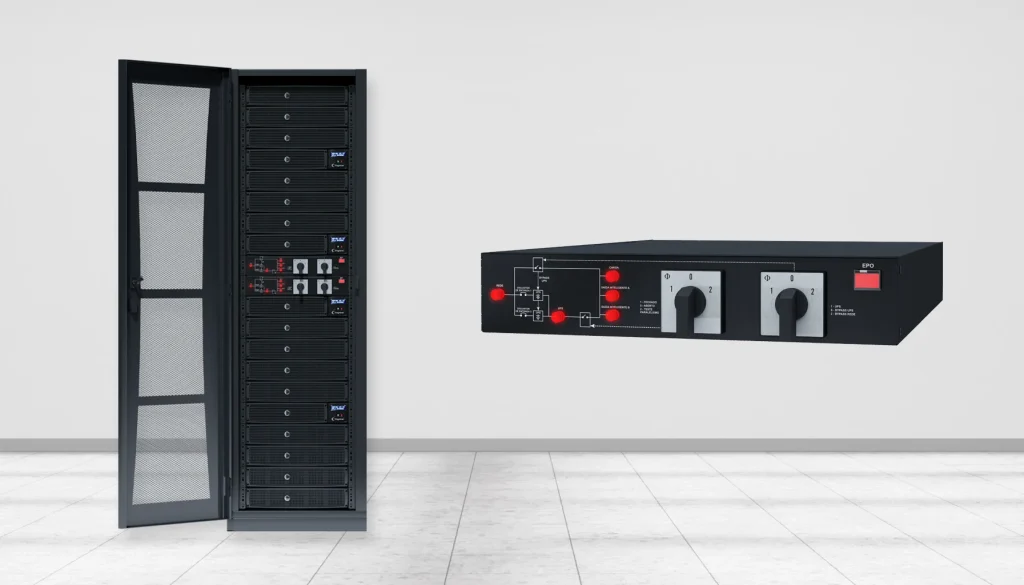
The QMI – Intelligent Control Panel makes maintenance of systems using modular UPS/uninterruptible power supplies more practical and safe. Unscheduled interruptions can result in losses due to forced shutdowns and potential vulnerability of the loads.
To discuss how QMI makes this process safer, we invited Nikolas Augusto – product analyst at Engetron – to explain more about the development of this technology.
What is QMI?
The QMI was developed to combine practicality and safety during maintenance on infrastructures with Engetron’s modular uninterruptible power supplies (UPS).
According to Nikolas, “QMI allows for safe transfer maneuvers between one or more UPS modules and the grid, ensuring power continuity during corrective and preventive maintenance on equipment. Some QMI models facilitate the configuration and installation of UPS systems operating in parallel.”
Furthermore, he also points out that the panel has a group of intelligent outputs, in addition to the main output, for connecting loads whose power supply will be controlled by the UPS/uninterruptible power supply.
What are the QMI Engetron models?
Engetron has created different QMI models to be installed according to the electrical configuration, line, and number of UPS/uninterruptible power supplies planned.
QMI for single-phase/two-phase electrical configuration
To install modular uninterruptible power supplies (UPS) with single-phase or two-phase configuration from the product line. Double Way Single Phase Modular, Three distinct QMI models can be used:
- QMI01-MM: Installation of a UPS/uninterruptible power supply in a single (N+0) configuration;
- QMI02-MM: Installation of two uninterruptible power supplies (UPS) in a redundant parallel configuration (N+1);
- QMI03-MM: Installation of three uninterruptible power supplies (UPS) in a redundant parallel configuration with a capacity of (2N+1).
QMI for three-phase electrical configuration
To install modular uninterruptible power supplies (UPS) with the three-phase power supply of the line. Double Way Three-Phase ModularThe following QMI models can be used:
- QMI01-TT: Installation of a UPS/uninterruptible power supply in a single (N+0) configuration;
- QMI02-TT: Installation of two uninterruptible power supplies (UPS) in a redundant parallel configuration (N+1).
How does QMI work?
The QMI is practical and provides greater safety for installations with modular UPS systems. With Engetron technology, it becomes even more powerful.
“This accessory also allows for the parallel operation of UPS systems and the selective shutdown of loads through intelligent outputs. In addition to removing the UPS for maintenance – while preserving the mains power output via a bypass switch or another UPS in the case of the QMI02 and QMI03 – there is also emergency shutdown via the integrated EPO button,” says Nikolas.
Key Elements of QMI
Learn about the key elements of the different types of QMI:
-
External bypass without interruption
The QMI has a built-in external bypass switch that allows the UPS/uninterruptible power supply to be completely removed for maintenance, thus keeping the loads powered.
Thus, critical loads can continue operating, being supplied directly from the electrical grid via the bypass, while the removed UPS/uninterruptible power supply is undergoing maintenance.
-
Smart exits
The QMI smart output group serves to connect loads that will have a power supply of energy Controlled by the uninterruptible power supply (UPS), configurable via the Engetron UPS resident software.
For example, it allows secondary loads to be switched off during a power outage or after the remaining autonomy falls below a certain programmed value. As a result, the availability of autonomy for the remaining loads connected to the QMI’s main output is extended. Thus, the outlets will be switched back on when the UPS returns to operating with mains power at the input.
“The smart outlet can also be used to power emergency lighting, for example. If there is a power outage, the lighting will turn on and then turn off again when the power grid has restored its supply,” Nikolas points out.
-
EPO button
In case of emergency, UPS/uninterruptible power supplies can also be switched off using the EPO button (acronym for Emergency Power Off), located on the front of the QMI. Thus, when this button is pressed, the loads connected to the main output and the smart output of the QMI will be switched off.
Advantages of QMI in modular UPS/uninterruptible power supply installations
The advantages of having Engetron uninterruptible power supplies (UPS) connected to the QMI are numerous. Learn about the main ones below:
-
Installation versatility
Like other Engetron modular UPS systems, the QMI allows for installation in tower (vertical) or 19” rack (horizontal) positions. Consequently, the versatility of this equipment’s installation optimizes the physical space required for the power infrastructure.
-
Safety in maintenance operations
The QMI incorporates circuit breakers to protect the input of each UPS/uninterruptible power supply. Through these circuit breakers, the QMI ensures safe operation and maintenance of the power modules.
Nikolas states that “users of the equipment can also rely on visual signage to indicate the presence of power at the input and outputs (general and smart).”
-
Practicality
QMI goes beyond a simple accessory for UPS installation. Therefore, using QMIs with Engetron’s modular UPS systems is the right way to maintain your… infrastructure protected without compromising safety and ease of maintenance.
Do you understand what QMI is and want to learn more about Engetron’s solutions for installations with modular UPS systems?
So, check out the Rack Solutions and services from Engetron!