





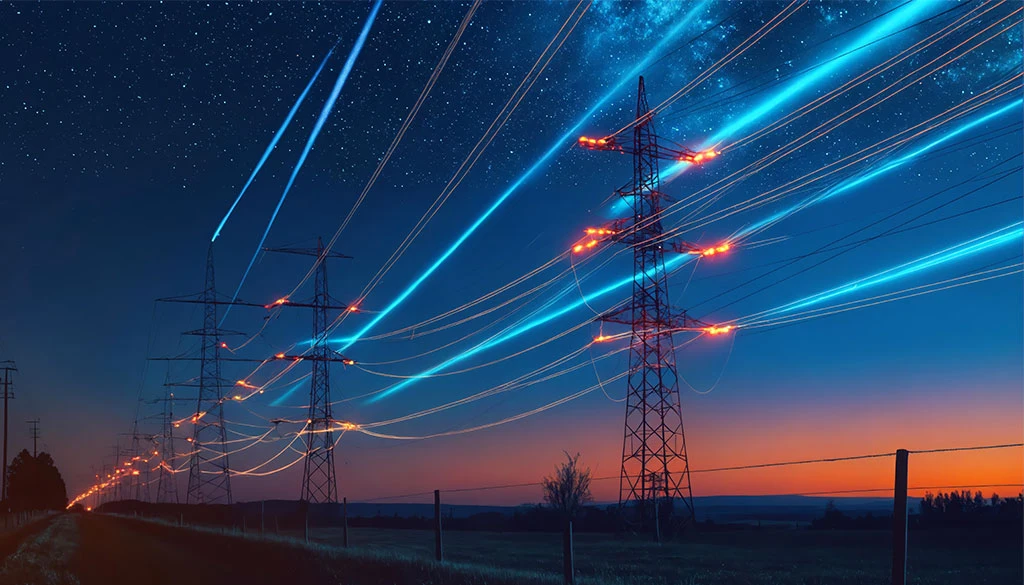
Expanding energy infrastructure is a growing demand, given society’s increasing dependence on electricity. However, the pace of this expansion faces difficulties in keeping up with the growing energy demand. Therefore, expanding generation sources, facilitating the transition to clean energy, among other actions, is one of the fundamental strategies for expanding this infrastructure.
Furthermore, maintaining the energy infrastructure operational and without interruptions is fundamental for environments such as hospitals, data centers, and businesses in general.
So, keep reading and learn more about the subject!
What is energy infrastructure?
Energy infrastructure refers to the set of energy facilities and networks. This includes:
- Power plants (such as hydroelectric, thermal, wind and solar farms);
- transmission lines;
- substations;
- distribution networks;
- energy storage systems.
Therefore, it is crucial for supplying energy to the residential, industrial, and commercial sectors. Consequently, the efficiency and modernization of this infrastructure are fundamental for a sustainable energy transition. Furthermore, energy infrastructure includes electricity generation and other forms of energy (natural gas; fossil fuels; etc.).
It is important to highlight that this system involves several steps, such as:
- Generation: Energy is produced in power plants that use coal, gas, oil, nuclear power, hydroelectric power, and renewable sources. Each type of generation has challenges in terms of efficiency, environmental impact, and cost.
- Transmission: Electricity is transported over long distances through high-voltage networks to consumption centers. Transmission lines connect generating plants to urban and industrial areas.
- Distribution: After transmission, the electricity passes through substations and the voltage is reduced to levels suitable for residential and commercial consumption. Then, the energy is distributed to end consumers.
- Storage and demand management: With technology, storage systems ensure network stability and the utilization of intermittent sources. Thus, demand management and smart grids optimize energy use and reduce waste.
In short, energy infrastructure is essential for economic growth and social well-being. However, it faces challenges such as modernization, adaptation to climate change, and the increasing demand for clean energy, to name a few examples.
What should be considered when expanding energy infrastructure?
Strategic planning policies and investments ensure an effective transition to a sustainable and accessible system.
Here are some things to consider when expanding your energy infrastructure:
- Firstly, structure plans for expanding investments, including resources for technological innovation;
- to consider as a premise the improvement of the efficiency of existing systems;
- To structure mappings of possibilities for expanding generation capacity, prioritizing clean energy sources;
- Implement public policies that guarantee a continuous, well-distributed, and secure supply.
Phases of energy infrastructure expansion
Certainly, expanding energy infrastructure is a fundamental strategic challenge for sustainable growth and energy security. Therefore, the expansion process involves increasing generation capacity and modernizing transmission and distribution networks.
The following are some of the main approaches to increasing and improving energy infrastructure:
-
Modernization and expansion of transmission networks
To support the growth in power generation, it is necessary to expand high-voltage transmission networks. Therefore, modernizing these networks is essential to avoid overloads and energy losses.
Therefore, the following actions are necessary to modernize and expand energy networks:
- Construction of new transmission lines to connect remote areas (where many renewable energy sources are located) to demand centers;
- Implementation of smart grids (smart grids), which use sensors and digital technologies to optimize energy flow, detect faults, and reduce waste;
- To improve regional interconnection between different countries and regions to enable energy exchange and increase resilience.
-
Development of energy storage systems
Increasing energy storage capacity is vital to ensure electricity is available even when weather conditions are unfavorable. Therefore, storage systems such as large-scale batteries and hydrogen technologies play a crucial role.
Actions needed to develop energy storage systems:
- Investing in storage technologies, such as lithium batteries, flow batteries, and hydrogen energy storage;
- Develop infrastructure to store electricity and release it during peak demand or when production is low;
- Create capacity markets that reward investors for holding reserve energy.
-
Expansion of distribution infrastructure
The power distribution network needs to be expanded and upgraded to ensure access to electricity in urban and rural areas. However, in many developing countries, rural electrification remains a challenge.
Actions needed to expand the distribution infrastructure:
- Extending the electricity grid to underserved areas, especially in rural and remote communities.
- To improve network efficiency in order to reduce technical losses in distribution;
- To promote the use of microgrids in isolated areas, using localized energy sources such as solar or biomass.
Conclusion
Therefore, expanding energy infrastructure is a process that requires planning, investment, and cooperation between governments, businesses, and society. Furthermore, the installation of uninterruptible power supplies (UPS) is essential to ensure the security of this infrastructure.
Uninterruptible power supplies (UPS) guarantee an uninterrupted power supply in case of network failures or instabilities, protecting equipment and preventing significant operational losses. In this sense, Engetron’s IoT UPS systems are designed to offer high efficiency and security, ensuring business continuity in mission-critical environments.
Consequently, by incorporating Engetron UPS (Uninterruptible Power Supply) In electrical infrastructure, resilience against power outages and fluctuations is significantly increased. Therefore, in addition to investing in smart grids, efficient storage, and renewable energy sources, the use of uninterruptible power supplies (UPS) ensures that critical operations continue to function even during interruptions, contributing to a more robust, secure, and reliable energy system.