





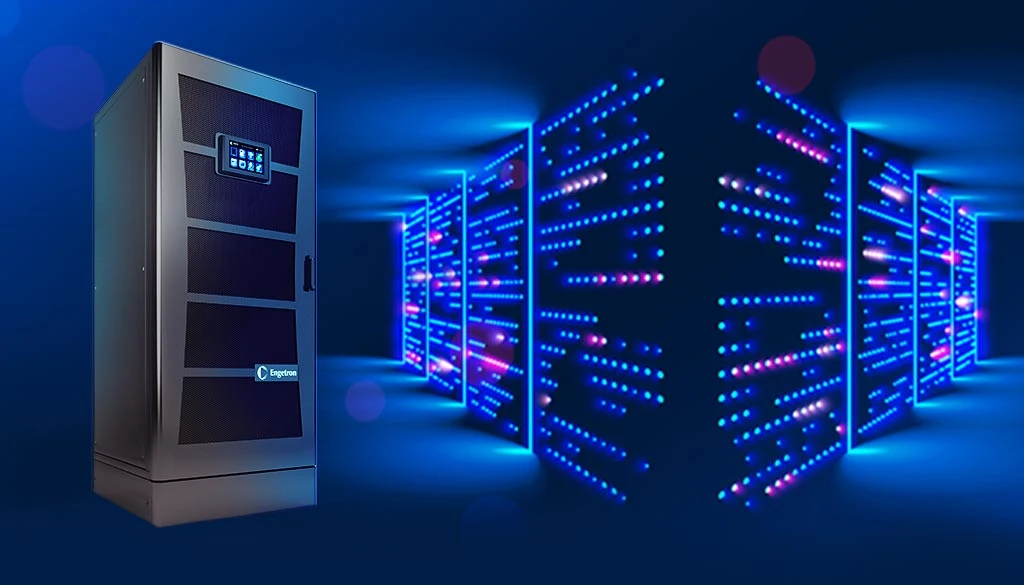
In UPS systems, it’s impractical to check each one individually to ensure it’s functioning correctly. Therefore, it’s crucial that these environments contain reliable equipment that guarantees the continuous execution of activities and services.
In a data center, the reliability rate of uninterruptible power supplies (UPS) must be high to prevent data loss and financial damage in case of failures. Therefore, understanding What is reliability? This can help in choosing a UPS.
You’ve probably heard of this concept before. But do you know what it means and how to improve the reliability of UPS systems?
In this post, we’ve compiled everything about reliability. Additionally, we’ve included tips on how to increase UPS reliability and how Engetron can help you with that.
Enjoy your reading!
What is reliability and why is it important?
According to NBR 5462 (ABNT – 1994)Reliability is the “ability of an item to perform a required function under specified conditions for a given period of time.” In UPS or mission-critical systems, it refers to the equipment’s ability to provide power without failing.
The reliability of a piece of equipment can be assessed through several calculations. For example, the indicator MTBF Mean Time Between Failures (MTBF) measures the probability of a component failing, indicating the average time between failures.
Another important calculation is the MTTR Mean Time To Repair (MTTR) is the average time it takes for a system to be repaired after a failure. This parameter is crucial in critical systems, as delays in resolving a failure can lead to problems with other components and affect the critical load.
Therefore, in a data center, the reliability rate of uninterruptible power supplies (UPS) must be high to avoid data loss and financial damage in case of failures.
How can we improve the reliability of UPS systems?
Below are some measures to increase the reliability of your UPS.
1) Implement redundancy in the facilities.
Redundancy is fundamental in critical applications, and it’s a widespread concept in the IT field. By repeating critical components, reliability is improved because, if a failure occurs in the primary system, a secondary system takes over. Therefore, UPS reliability is highly impacted by the use of redundant configurations. Since IT equipment cannot be allowed to stop, a redundant power system also increases availability and fault tolerance.
In the case of UPS systems, redundancy can be created in two ways. In parallel operation, two or more devices are used to provide power in a distributed manner. If one fails, the other takes over the entire power supply.
In a dual-bus system, the critical load has redundant power supplies which, in turn, are powered by individual uninterruptible power supplies (UPS). Therefore, the more redundant the system, the more reliable it will be, according to… Tiers scale from I to IV.
2) Use compatible technical specifications.
All equipment in an IT system has power and consumption specifications that must be considered. The UPS used must be compatible with these characteristics to ensure efficiency and prevent overload.
Furthermore, it is also worth investigating its quality and its battery bank, in order to ensure that they can withstand the load for the required time.
3) Perform the appropriate sizing.
We deal with different types of critical loads, which vary in size and power requirements. Therefore, the UPS system must be able to support them to ensure maximum reliability. Furthermore, this system must allow for future expansions.
Precise sizing ensures investment optimization and eliminates the risk of overload or any other type of UPS incompatibility. To this end, Engetron has an Application Engineering team, fully prepared to help you define the best solution.
4) Analyze the environment’s infrastructure.
When understanding what reliability is, we must also evaluate the environment’s infrastructure, as it influences the choice and placement of the UPS, as well as the overall power system.
For example, the electrical infrastructure must be correctly sized. Similarly, the physical space must be able to properly house the system, allowing access for maintenance without obstructing the UPS ventilation system in any way.
Therefore, a prior analysis of all the elements and equipment already in use helps in deciding which types of UPS to choose. Consequently, it is possible to use the investment budget more accurately.
5) Install a real-time monitoring system.
Reliability is also achieved through constant monitoring. Therefore, tracking the operation of each UPS is a way to identify recurring failures, prevent problems, and verify that the model is performing as expected.
For this, practical solutions, such as Engetron’s IoT app, They make things much easier. With it, you can manage the entire energy system. You can monitor aspects such as:
- Alarm and incident statistics;
- status of each UPS;
- Individual battery monitoring;
- Diagnostics with over 50 measurement channels.
It is important to emphasize the need to do the necessary maintenance Regarding the UPS, reducing the frequency of service according to the periodicity established by the UPS system manufacturer. Therefore, it’s worthwhile to have an organized plan that can be followed by the entire team involved.
6) Create contracts with SLAs.
The company that supplies your UPS is also responsible for its operation. Therefore, by understanding reliability, you can use this concept to choose not only the supplier but also the contracts.
In this case, it’s worthwhile investing in models with SLAs that offer fast response times. This allows the company to assist you during crises, ensuring your data center isn’t at risk.
How can I have a reliable UPS system with Engetron?
As you’ve seen, UPS reliability is achieved through several factors, but as long as they are all aligned, a high level of security is possible.
Therefore, choosing the right equipment is so important and should be done with trustworthy companies, as well as using modern solutions, to minimize any problems with the UPS (Uninterruptible Power Supply).
In this case, Engetron can be your partner. Operating since 1976 with energy solutions, it works in all the necessary phases to offer the best energy solutions to its clients. In the pre-sales phase, the main focus is on sizing and analyzing your infrastructure to propose the best solutions.
With modern, domestically produced UPS systems, validated according to the relevant standards, you can get your operations up and running, and you’ll also have the support of a nationwide technical assistance network.
Want to know how your UPS system can be even better? Receive a technical proposal from Engetron’s engineers!