





Uninterruptible power supplies (UPS) are a great investment for your company to ensure the continuity of its services. Through them, it’s possible to protect assets and keep your company’s critical loads away from any risk of irreversible damage, especially when you can take advantage of the benefits offered by a sinusoidal UPS.
Each UPS (Uninterruptible Power Supply) is suited to different needs of an establishment. Therefore, it’s necessary to consider your workflow in order to make the right decision. After all, it’s important to consider the… autonomy time to offer a pleasant and safe experience for both internal and external audiences.
If you want to learn more details about a type of UPS that is fully compatible with your company’s critical loads, continue reading and expand your knowledge through the following topics!
What are the functions of a UPS (Uninterruptible Power Supply)?
An uninterruptible power supply (UPS) is a key strategy in many business continuity plans. Its importance stems from the fact that it’s necessary to explore its functions further to ensure your company makes a sound investment in this device.
Uninterrupted power supply helps protect your company’s data when a power outage occurs and prevents equipment from shutting down at crucial times.
The UPS also regulates the mains voltage, protects your company against voltage spikes and power surges, and provides stable, clean power without any noise.
As soon as the power supply from the utility company ends, your batteries They are triggered automatically, and it works according to the time you have set so that the service continues and no losses occur in the corporate environment.
Even if your company has a cloud storage system, experiencing abrupt computer and server shutdowns creates problems for employee productivity.
Even if the region where your company is located suffers from frequent power fluctuations, it is very important to invest in a UPS (Uninterruptible Power Supply) to stabilize the electrical voltage and prevent power surges from damaging or burning out equipment, which would result in much higher costs. corrective maintenance.
Why is it important to understand the differences between their types?
When we mention critical workloads, we are talking about high-performance computers and machines or medical equipment which have state-of-the-art technology.
These devices require a very high level of protection to ensure they always provide stable and clean power for workflow procedures. Therefore, it is essential to choose a UPS that meets these specifications.
Ultimately, every UPS (Uninterruptible Power Supply) has a certain… autonomyThe power consumption can vary depending on the connected load and battery capacity. Below, we will show essential details so you understand the differences between a sinusoidal UPS and other types. Check it out!
square wave UPS
This type of UPS (Uninterruptible Power Supply) provides power in square waves. It is suitable only for computers, routers, and printers. It offers a very affordable and accessible price for small businesses.
However, this type of UPS has a transfer time greater than zero, meaning that when the power supply from the utility company is interrupted, there is a delay between the power outage and the UPS kicking in. This switch-off is not instantaneous and is not entirely stable enough to build a… uninterruptible power supplyThis can shut down your critical workloads, causing your company’s data to be lost.
Sinusoidal UPS
Also known as double conversion uninterruptible power supply (UPS) Whether online or offline, a sinusoidal UPS offers high performance that ensures the stability of your electrical network.
In addition to providing high protection against fluctuations and being recognized for helping to extend the lifespan of the product, the product is known for providing high protection against fluctuations. lifespan Of the equipment options, the sinusoidal UPS is more expensive than the previous solution, but it offers a pure sine wave that closely resembles mains power. In this type of UPS, the transfer time is zero, providing an instantaneous switch between a power outage and the activation of the UPS battery bank.
It is compatible with various critical loads, such as servers, electric motors, and especially equipment used in hospitals, clinics, and health centers.
This type of UPS (Uninterruptible Power Supply) offers a high-quality power source, especially in regions with frequent power outages. It is recommended for various types of businesses and data centers.
What should you consider when choosing between a sine wave UPS?
First, it’s necessary to calculate the operating time that the equipment connected to the UPS should have during a power outage. The issue of runtime is crucial when choosing a UPS.
Specifically, a sinusoidal UPS, depending on the load, offers autonomy ranging from 5 minutes to several hours. The greater the autonomy, the greater the number of batteries the UPS will need to handle these critical loads. For this reason, there are external battery banks with various capacities, measured in ampere-hours (Ah).
Another factor is the power consumption, which needs to be calculated in relation to each device’s power consumption. It’s also important to check the number of outlets available on the UPS and whether they are compatible with your company’s equipment, or if the connection will be via terminals.
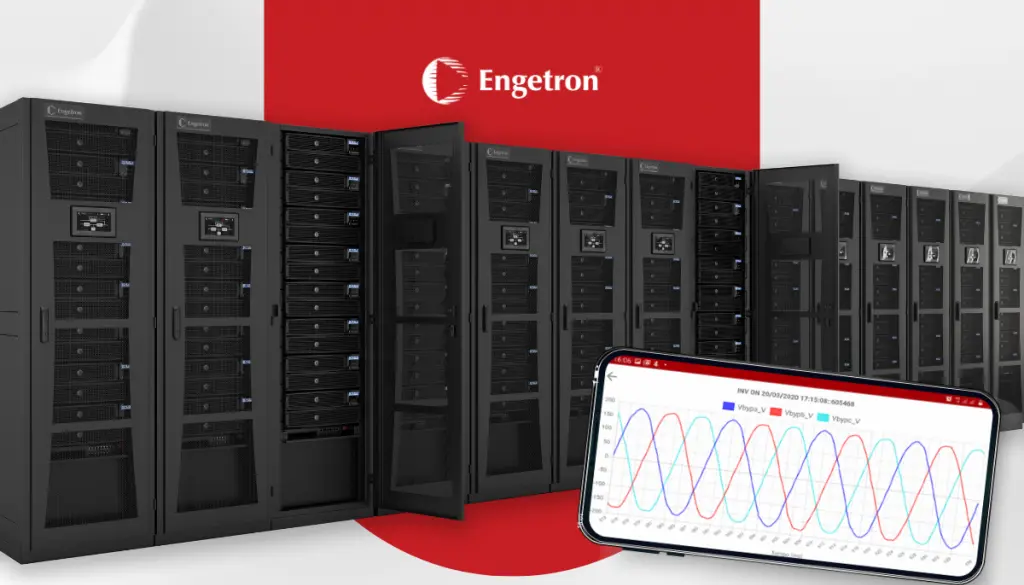
Technology is essential in our lives and is present in some UPS models, which have IoT technology (Internet of ThingsThey send alerts via apps or directly to your email in situations of power outages and other events. You can even see the battery status in real time and monitor the power quality behavior graphically, through the digital oscilloscope integrated into the UPS.
Finally, don’t forget to choose a brand that has available technical support and a good reputation in the market. After all, it’s essential to have partner brands that understand your needs and are available to provide support at any time.
This set of factors allows you to make an assertive decision focused on a model that offers excellent cost-benefit and provides advantages for the long-term continuity of your business.
However, to achieve this, it is essential to take care of the lifespan of the batteries, perform preventive maintenance, and follow a set of strategies to optimize consistent results in your business.
In this content, you learned the difference between a sinusoidal UPS and other types. If you want more security protection for your critical loads, opt for a brand with experience in the market.
Engetron is a leader in the energy solutions segment and has been helping the corporate market adopt uninterruptible power supply (UPS) technology since 1976. Visit the website and discover its unique features..