





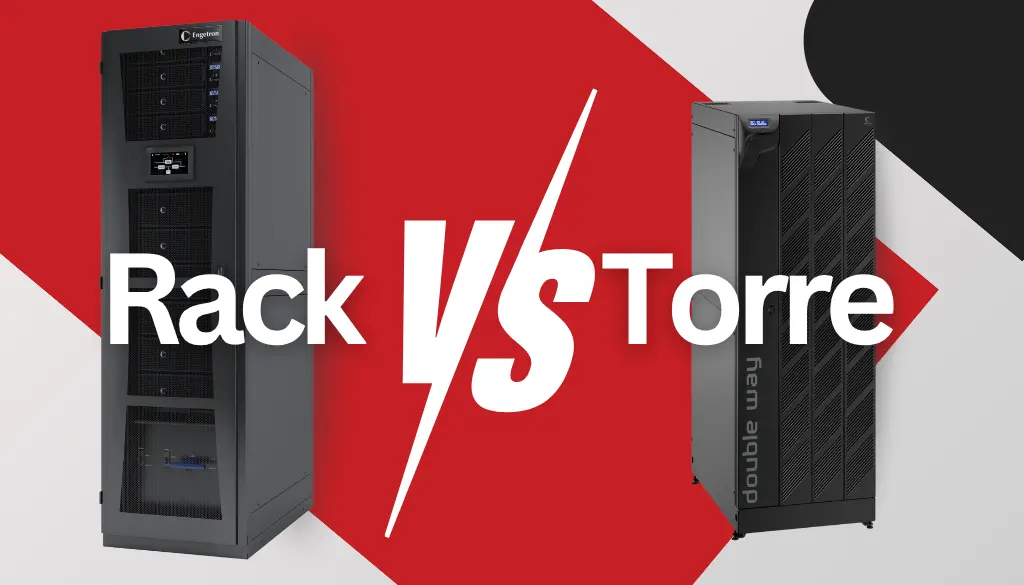
An entrepreneur’s decision-making process must consider several factors that allow them to make an intelligent choice, focusing on improvement and opportunities for brand expansion. In this context, the rack versus tower configuration in uninterruptible power supply (UPS) topology becomes absolutely necessary.
If you want to invest in a uninterruptible power supply system To provide better protection against power surges, it’s important to invest in a UPS (Uninterruptible Power Supply) that provides clean, pure power to specific equipment and machinery used in your service provision.
In the following sections, we will present some important information highlighting the differences, advantages, and disadvantages of these two UPS (Uninterruptible Power Supply) formats. Continue reading and enjoy!
What are the main definitions of rack and tower topologies?
Uninterruptible power supply (UPS) systems offer significant advantages for businesses, industries, and even homes. If you’re organizing a corporate event to enhance brand reach and launch new products and services, a UPS is an excellent choice for uninterrupted power supply, especially in regions that experience frequent power fluctuations and outages.
Each UPS has… batteries that transmit energy according to the time of autonomy established. In this way, your company will be able to continue its services without data loss on servers and computers that are part of the constant collection and storage.
Currently, it’s impossible to live without this type of device in the reality we live in. Data is constantly used to improve our decision-making, comply with the LGPD (Brazilian General Data Protection Law), focus on digitizing processes, and invest in increasingly effective strategies to improve attracting and closing deals with the target audience.
Therefore, to protect against undervoltage, frequency noise, surges, and even blackouts, it is essential to choose the right… best uninterruptible power supply (UPS) that suits your needs. However, an alternative that matches your structure and is in a format relevant to your business is recommended.
First, we have the “tower” type UPS, which is seen as a compact device and can even be placed under a desk; it doesn’t take up space in your corporate environment.
Next, there’s the rack-mounted UPS, a device positioned horizontally that typically houses servers with two processors for storage. If you want to expand the power or runtime in the future, there are also models that can accommodate this need for your business. In addition, it also has servers for security, online applications, files, and virtualization.
The tower topology UPS, on the other hand, is positioned vertically and has a server that is entirely focused on optimizing business systems, allowing for the aggregation of information on a single platform, as is the case with ERP and CRM systems.
It also offers the opportunity to expand autonomy and power, and features two processors that ensure optimal data storage, as well as easier cooling and greater security when accessing files for networks, storing important data in databases so that your system is not vulnerable to intrusions and cyberattacks.
Why is it necessary to understand the differences between the models?
Every uninterruptible power supply (UPS) has features that suit different purposes. By understanding the differences between rack and tower topologies, you can choose a UPS that fits your needs. infrastructure and ensure the best performance from the equipment that will be connected to it.
If you intend to expand your company and focus on scalability, one of these options is best suited to that goal. In addition, consider the initial costs of implementing this device. After all, there are more economical options at the beginning, but the other option may have features that make your processes even more efficient.
What are the differences between rack and tower topologies in uninterruptible power supplies (UPS)?
In terms of organization, rack topology allows for better cable management, making it suitable for a modular data center. However, if you need a UPS for a specific number of devices, tower topology would be a better fit.
The tower has a visually pleasing design and is easy to install in various environments. Racks, on the other hand, tend to require a much more robust infrastructure due to the high density of devices and equipment used.
The tower topology has the characteristic of offering a maintenance More affordable and less expensive compared to a rack, which has the disadvantage of requiring floor space for installation and a structure that fits perfectly into server rooms. A tower UPS, on the other hand, is quite suitable for offices, home offices, and small businesses.
Typically, the difference lies in the design, shape, and size, but it’s important to remember that they all provide the necessary protection for your equipment against power surges and voltage drops.
If your company finds that both options offer highly relevant functions, there are hybrid models that can perfectly suit your needs and provide an option that offers a… best cost-benefit ratio.
What should you prioritize to make the right choice?
If you have a structure with few devices in your corporate environment and need to manage your activities in an easier and more practical way, the tower topology is the best choice, since it is possible to increase its autonomy and have the possibility of connecting external batteries.
However, if your company relies on a high-performance data center and has multiple pieces of equipment, it’s better to use a rack-mounted UPS, as it offers more robust power distribution and includes cooling systems that ensure the high performance of the computers and other equipment that are part of this infrastructure.
In this content, you learned the differences between rack and tower topologies. You noted that both alternatives have advantages and disadvantages. Therefore, use the information in this article to understand the differences and make an increasingly informed choice.
If you enjoyed this article, stay with us and check out more! The main reasons why you should buy a UPS (Uninterruptible Power Supply)..