





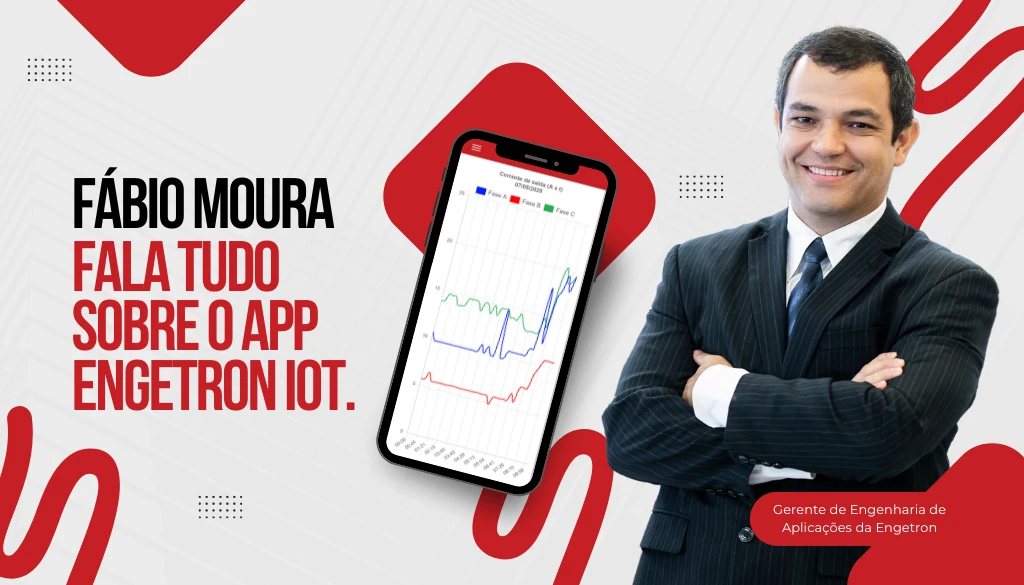
Engetron IoT is a system that provides real-time remote diagnostics and interventions on uninterruptible power supplies (UPS). This allows owners to avoid losses, optimize power availability, and reduce the need for on-site maintenance visits. However, this is only a summary of all its functionalities.
This post features a special contribution from Fábio Moura, application engineering manager at Engetron. He explains the main functionalities, benefits, and applications of the Engetron IoT App. Enjoy reading!
What is the Engetron IoT App?
The Engetron App IoT is an application for monitoring uninterruptible power supplies (UPS) Based on Internet of Things (IoT) technology. Cloud management considers that, on one side, there is the uninterruptible power supply (UPS), which signals its functional status to the Engetron IoT server.
In turn, the server processes this information so that the user can use the app to easily and securely access information related to the UPS (Uninterruptible Power Supply).
The main objective of the Engetron IoT application is to assist its users in preventing failures. “The UPS provides precise measurements of the electrical quantities around it and a wide variety of signals that can indicate to the user the presence of an alarm or a warning condition that represents a potential risk to the critical load,” says Fábio.
As this information becomes accessible in an intelligible way for the user, preventive and planned actions can be programmed to act before a critical event can occur.
Active management of uninterruptible power supplies (UPS) It is also a strong ally in mitigating events, as real-time updates and event logs allow for precise analysis of any changes in behavior. critical load or from the UPS.
Fábio explains that the app classifies the status of the equipment and uses colors to prioritize alarms and alerts, such as the need to perform preventive or corrective maintenance.
How are remote UPS diagnostics performed using this tool?
All functional information of uninterruptible power supply (UPS)Electrical quantities, event logs, and alarm signals are generated by the UPS itself. This data is transmitted via secure network protocols to Engetron’s IoT server.
“The magic happens on the IoT server,” Fábio explains. Automated routines analyze the received data and, once an anomaly is identified, the user is informed via local app notifications and by email.
The system provides the user with accurate data, such as: internal temperature, power consumed by the load, battery bank autonomy in in case of power outage, regarding mains voltages and currents or UPS output voltages and currents, in textual or graphical form using a virtual oscilloscope.
“The incident history and statistical data for each UPS are also presented,” points out the engineering manager at Engetron.
“It is possible to verify, for example:”
- how many times There was a power outage;
- When were you absent (day and time)?
- “For how long did this occur in each situation (in relation to the accumulated time and the last occurrence).”
In addition to the event log, electrical quantities can be analyzed in the form of historical graphs or by specific events using the virtual oscilloscope.
What actions does the app recommend at each status level?
The Engetron manager points out that the actions to be taken really depend on the status level, as they generally reflect some level of urgency.
Example 1: A temperature alarm requires quick action to check if the air conditioning or ventilation system in the UPS room is working.
If nothing is done, there is a risk of the UPS’s thermal protections activating. Fábio shows a second example: a power increase alert at the output indicates that there has been an increase in load on the UPS. This makes the person in charge analyze whether this increase is legitimate or if a regular load was accidentally connected to the stabilized network.
“The alerts indicate that an observed event requires user attention, but does not prevent the UPS from functioning,” explains the professional. An alarm, however, requires quick action from the user to eliminate the event.
What measurement channels does the application offer for uninterruptible power supplies (UPS)?
The application provides graphical or textual measurements of electrical quantities related to UPS operation, such as voltages, currents, input and output power, as well as battery charging and discharging current voltages.
There are other important parameters, such as autonomy, internal temperature, and operating mode. These are important functional indicators of the UPS, which help the operator understand the status of the individual equipment or the installed equipment fleet.
Regarding the data collected by the measurement channels, electronic meters sample various electrical signals in the UPS. Among them, the following can be highlighted: voltage, the current and functional parameters, such as internal sources.
The signals are then processed by a DSP (Digital Signal Processor). This data is used by the UPS itself to:
- analysis of the energy received from the grid;
- to guarantee the quality of the energy supplied to the load;
- and made available to the user through the management interface.
What are the key differences between Engetron IoT and other UPS management solutions?
The virtual oscilloscope is undoubtedly the main differentiating factor, according to Fábio. “It’s a feature with exclusive Engetron technology that allows you to graphically visualize the main electrical quantities related to the network or the UPS operation,” explains the manager.
This is a fundamental element for avoiding unnecessary interruptions in the power system, since it remotely provides data that was traditionally collected in person.
The Engetron IoT app also offers other advantages. Among them, we highlight the user interface, which is intuitive and user-friendly. Geolocation and dashboards provide managers with a view of the operating status of the UPS systems and quick access to any equipment.
“Alert notifications are sent to managers when the signaling requirements are met,” emphasizes Fábio. The alerts indicate that some operating condition of the UPS, such as temperature and power, has exceeded predetermined limits and may turn into alarms if not analyzed.
Application security level
Data security is one of the cornerstones of the Engetron IoT system: access is controlled by secure login and password. Communication with the IoT server occurs via the secure HTTPS protocol (encrypted), along with Engetron’s own encryption.
Fábio clarifies that there is no direct communication between the application and the UPS: “the data generated in the UPS is sent through the network interface to the Engetron IoT Server. The application, in turn, accesses only the data from the IoT Server.”
The system does not depend on a valid internet IP address for each device, since the communication direction is from the UPS to the IoT Server. It is also important to note that user data is not transmitted: the information transmitted is exclusively related to the UPS operation.
Cost reduction in UPS maintenance.
The most significant gain in terms of reduced maintenance costs is the cost of unscheduled downtime, the expense of equipment unavailability. “The entire operation is based on the use of information to prevent failures,” says Fábio.
Even in corrective maintenance situations, the UPS’s accurate telemetry allows for rapid identification of the problem’s cause. This makes the service more focused and, consequently, the restoration of operations faster.
With Engetron IoT App, the owner of uninterruptible power supply (UPS) It will be possible to perform remote diagnoses and reduce costs associated with in-person visits. Furthermore, it also mitigates system interruptions, increasing availability.
Take advantage of your visit to the blog to Check out a demonstration of Engetron IoT.!